
- Introduction
- What Are Rocket League Ranks?
- Complete Rocket League Ranks List in 2026
- Rocket League Rank Distribution in 2026
- How the Rocket League Ranking System Works
- Rocket League Ranks by Game Mode
- How to Rank Up Faster in Rocket League
- Common Mistakes That Prevent Ranking Up
- Rocket League Rank Rewards Explained
- Why Most Players Get Stuck in Platinum and Diamond
- Rocket League Ranks vs Skill Levels
- FAQs
- Conclusion
Introduction
Climbing the Rocket League Ranks can feel frustrating when you keep winning some matches but still struggle to move up. One bad game, a few missed shots, or a tough teammate can make you wonder what you’re doing wrong.
In this guide, you’ll learn how the Rocket League Ranks work, what each rank means, and what you can do to improve your position. Whether you’re just starting your competitive journey or trying to reach the next tier, these tips will help you understand your progress and play with more confidence.
What Are Rocket League Ranks?
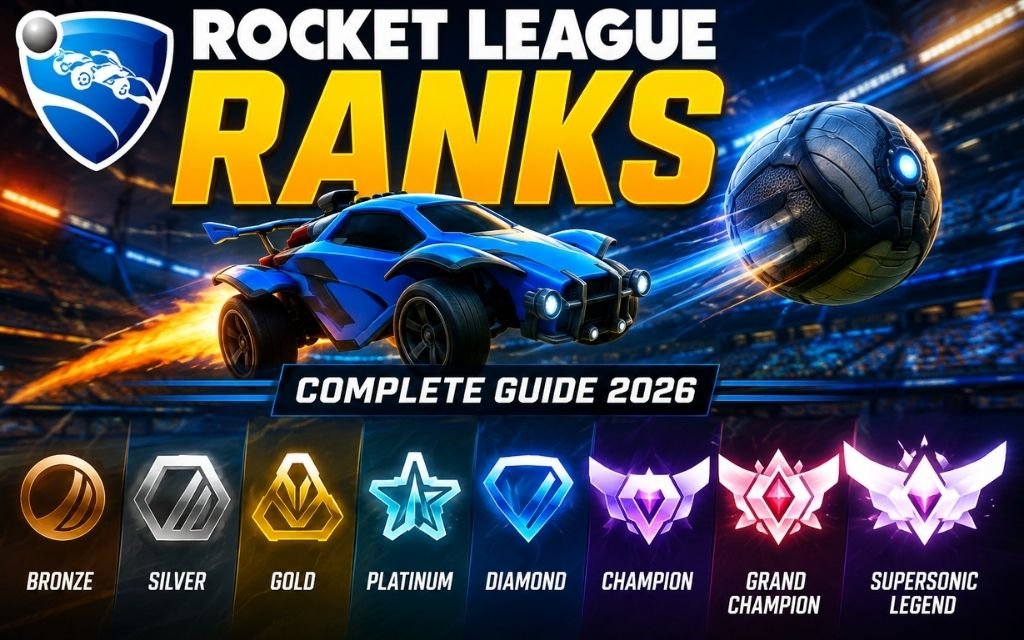
Rocket League ranks are a way of grouping players according to their competitive skill and matchmaking rating. The main competitive ladder moves from Bronze through Silver, Gold, Platinum, Diamond, Champion, Grand Champion, and finally Supersonic Legend. Each major tier is divided into smaller divisions that help track your progress within that tier.
Your rank isn’t a perfect measurement of everything you can do on the field. A player might have excellent aerial control but weak defensive positioning, while another might have average mechanics but outstanding game sense. The ranking system mainly gives you a competitive environment where you’re matched against players with broadly similar competitive ability.
Complete Rocket League Ranks List in 2026
The current competitive ladder has eight main rank tiers. Each tier, except Supersonic Legend, is divided into four divisions: Division I, II, III, and IV. This creates a clear progression path as you improve your mechanics, positioning, decision-making, and consistency.
Understanding the Rocket League ranks in order makes it easier to see where you are and what you’re working toward. Remember that rank requirements can vary by playlist because matchmaking ratings are tracked separately for different competitive modes.
Bronze
Bronze is the starting point for many newer competitive players. At this level, players are usually still learning basic movement, shooting, positioning, recoveries, and how to control the ball without giving away possession.
Don’t worry if your matches feel chaotic here. That’s normal. Focus on hitting the ball with purpose, learning when to challenge, and getting back toward your own goal after making a play.
Silver
Silver players generally have a better understanding of basic controls and can make simple shots and saves more reliably. Matches can still be unpredictable because players often chase the ball or rotate late.
This is a good stage to build strong habits. Start learning simple rotations, avoid unnecessary double commits, and pay attention to where your teammate is before charging into the play.
Gold
Gold represents a noticeable step forward in consistency. Players begin making stronger touches, better clears, more reliable shots, and more deliberate challenges.
At this level, positioning starts becoming just as important as mechanics. You don’t need advanced freestyle moves to climb. Smart challenges, good spacing, and controlled possession can win plenty of games.
Platinum
Platinum is where many players begin taking competitive play more seriously. Mechanics become faster, shots become more accurate, and players start using aerials and wall plays more frequently.
However, Platinum also exposes weaknesses in rotation and decision-making. If you constantly chase the ball or challenge without considering your teammate’s position, you’ll often leave your team exposed.
Diamond
Diamond players usually have solid mechanical foundations and can execute aerials, fast challenges, powerful clears, and more advanced shots. The pace also becomes noticeably faster.
At this stage, small decisions matter. A bad challenge can turn into an easy goal, while a smart rotation can create an attacking opportunity without requiring a spectacular mechanical play.
Champion
Champion is a highly competitive tier where consistency becomes extremely important. Players generally have stronger mechanics, faster reactions, better recoveries, and a deeper understanding of positioning.
You’ll also see more advanced mechanics and stronger team coordination. However, mechanics alone won’t carry you forever. Reading the play, controlling space, managing boost, and making good decisions under pressure become increasingly valuable.
Grand Champion
Grand Champion represents a very high level of competitive play. Players at this level tend to combine strong mechanics with excellent game sense, positioning, recoveries, and decision-making.
Mistakes are punished quickly. A poor rotation or unnecessary challenge can give opponents enough space to score. Players also need to adapt to teammates and opponents rather than relying on one fixed style.
Supersonic Legend
Supersonic Legend is the highest rank tier in the standard Rocket League competitive hierarchy. Reaching it requires exceptional consistency and a combination of advanced mechanics, game sense, speed, positioning, and decision-making.
The difference between reaching a high rank and staying there can be enormous. At this level, tiny advantages matter, and players must continually adapt as the competitive environment becomes more demanding.
Rocket League Rank Distribution in 2026
Rank distribution shows how players are spread across the competitive ladder. Instead of assuming that every rank contains the same number of players, think of the distribution as a snapshot of the game’s competitive population. The percentages can change between seasons, playlists, and matchmaking adjustments.
There isn’t one universal percentage that accurately represents every playlist. For example, the player distribution in 1v1 can differ from 2v2 or 3v3 because each mode attracts different players and demands different skills. Official patch notes have also shown that MMR thresholds can be adjusted between seasons to address population differences at particular ranks.
When looking at a Rocket League rank chart, always check the season, playlist, and date behind the data. A percentage from an older season shouldn’t automatically be presented as the exact 2026 distribution. This is especially important when comparing Diamond, Champion, Grand Champion, and Supersonic Legend populations.
How the Rocket League Ranking System Works
The Rocket League ranking system uses matchmaking ratings to place players into competitive games. Your visible rank represents a range of skill, while the underlying rating helps the matchmaking system find appropriate opponents and teammates.
Winning generally moves you upward, while losing can move you downward. Your progress isn’t based only on goals, assists, or saves. In team-based playlists, the most important factor is whether your team wins or loses, because the system is designed around competitive matchmaking rather than awarding rank points for individual statistics.
What Is MMR?
MMR stands for Matchmaking Rating. You can think of it as a hidden numerical representation of your competitive matchmaking level.
When you win against appropriate opponents, your rating generally increases. When you lose, it generally decreases. The exact amount can vary depending on factors such as matchmaking conditions and the rating relationship between players.
Your MMR helps determine where you sit on the competitive ladder. That’s why two players can have similar-looking ranks while being positioned slightly differently within the underlying rating range.
Division and Tier Structure
Each major rank tier is divided into four divisions. For example, a player could be Platinum I Division II or Diamond III Division IV.
These divisions provide smaller milestones between major rank tiers. Winning enough matches can move you up a division, while losing enough can send you down. The process isn’t always perfectly predictable after every single game because your underlying rating determines your position.
Think of divisions as steps on a staircase. The tier is the floor you’re standing on, while the divisions show how close you are to the next step.
Placement Matches Explained
Placement matches help determine where you begin your competitive journey in a playlist. New or returning players complete a set of placement games, and the results contribute to their initial competitive placement.
Official Rocket League competitive reward information has historically used ten placement matches to assign a rank. The game’s competitive system can then use subsequent wins and losses to move players through the ranking ladder.
Don’t treat placement matches as something you must win at all costs. Play normally, focus on good decisions, and avoid changing your entire playstyle because you’re worried about the result of one match.
Seasonal Rank Resets
Competitive seasons can include a reset or soft reset that changes where players begin the new season. A soft reset doesn’t necessarily mean everyone returns to the exact same starting point.
Rocket League has used seasonal adjustments to competitive MMR in the past, including changes designed to reduce how far higher-ranked players fall after a reset.
Because seasonal systems can change, always check the current season’s official patch notes for the latest reset details. Your previous rank can influence your starting position, but the exact behavior can vary.
Rocket League Ranks by Game Mode
Competitive ranking isn’t identical across every playlist. A player who is excellent in 1v1 might not immediately perform at the same level in 3v3 because team positioning, rotations, communication, and space management become much more important.
The same idea applies to Extra Modes. Rumble, Hoops, Dropshot, and Snow Day introduce different rules and situations. Each mode can reward a different combination of mechanics and decision-making, so your skill in one playlist doesn’t automatically transfer perfectly to another.
1v1 Duel Ranks
1v1 Duel puts almost everything on your shoulders. There is no teammate to cover a missed challenge, rotate behind you, or finish a play after you lose possession.
Because of that, 1v1 strongly rewards ball control, recoveries, boost management, defensive patience, kickoffs, and accurate shooting. A player who constantly gives the ball away can struggle even with excellent mechanics.
2v2 Doubles Ranks
2v2 is one of the most popular competitive formats because it gives players more space while still requiring strong teamwork. You need to know when to challenge, when to rotate, and when to leave the ball for your teammate.
Good spacing is critical. If both players attack the same ball, the entire net can become exposed. Strong 2v2 players understand that sometimes the best play is simply allowing their teammate to make the challenge.
3v3 Standard Ranks
3v3 introduces another layer of positioning. With three players on each side, rotations need to be faster and more organized.
Players must understand first, second, and third-man responsibilities. The third player often provides defensive security while teammates challenge or attack. Poor spacing can leave huge gaps that opponents exploit immediately.
Extra Modes Rankings
Extra Modes add variety to competitive play. Depending on the available playlists, players may encounter modes such as Hoops, Rumble, Dropshot, and Snow Day.
These modes reward different skills. Rumble adds power-ups and unusual situations, Hoops changes the goal structure and aerial requirements, Dropshot emphasizes controlled touches and floor damage, while Snow Day changes how the puck behaves. Official Rocket League competitive reward systems have historically included these modes alongside standard competitive playlists.
How to Rank Up Faster in Rocket League
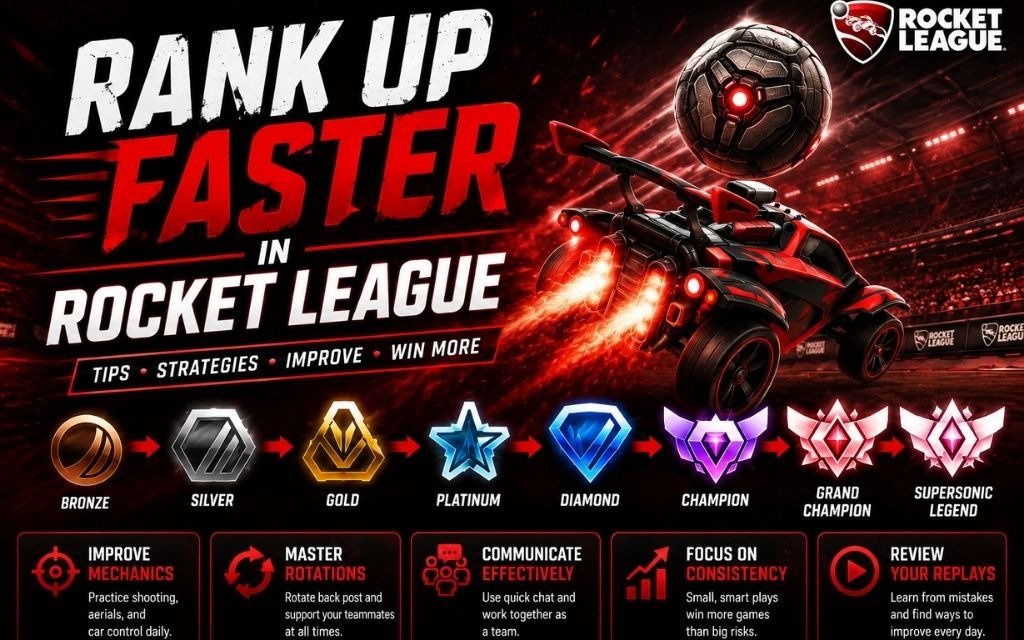
The fastest way to improve isn’t usually learning one impressive mechanic. It comes from removing repeated mistakes while building reliable fundamentals.
If you want better Rocket League Ranks, focus on the parts of your game that appear in every match. Better rotations, cleaner touches, smarter challenges, stronger recoveries, and consistent positioning can produce more wins than flashy mechanics you rarely use successfully.
Improve Your Mechanics
Mechanics give you more options when you’re under pressure. Start with fundamentals such as accurate shooting, controlled touches, aerial control, recoveries, dribbling, and wall play.
You don’t need to master every advanced mechanic. Instead, choose skills that directly solve problems in your matches. If you keep missing aerials, practice aerial consistency. If opponents constantly steal the ball from you, work on first touches and possession.
Master Rotations
Good rotations help your team stay organized. After making a challenge, don’t automatically chase the ball again. Sometimes the strongest play is rotating out, collecting boost, and allowing your teammate to take over.
Pay attention to defensive positioning and offensive rotation. A player who rotates well can create pressure without constantly touching the ball.
Communicate With Teammates
Communication doesn’t require long conversations. Quick Chat can provide useful information such as letting teammates know you’re defending, passing, or taking a shot.
More importantly, communicate through your positioning. If you rotate properly and maintain good spacing, your teammate can often understand your intentions without any message.
Avoid blaming teammates after mistakes. Arguments don’t improve your competitive performance, and frustration often leads to worse decisions.
Focus on Consistency
Consistency is one of the biggest differences between climbing and staying stuck. You might score an amazing goal once, but reliable shooting, recoveries, clears, and rotations can influence dozens of plays.
Try to reduce unforced errors. If you stop giving away possession, stop double committing, and make safer defensive decisions, you’ll create more opportunities to win.
Review Your Replays
Replay review can reveal mistakes you don’t notice while playing. Watch a few losses and look for repeated patterns instead of focusing only on goals.
Ask yourself simple questions. Was I too far forward? Did I challenge myself too early? Did I leave my teammate alone? Did I waste a boost? Could I have rotated instead of chasing?
Finding one recurring mistake and fixing it can be more valuable than watching hours of advanced tutorials.
Common Mistakes That Prevent Ranking Up
Many players blame matchmaking when their progress slows down, but repeated habits often have a bigger impact. One of the most common problems is chasing the ball without considering teammates, opponents, or the next play.
Double commits are another major issue. When two teammates challenge the same ball and both miss, the opposing team often gets an open counterattack. Other common problems include poor boost management, weak defensive positioning, unnecessary aerial attempts, playing while tilted, and overcommitting after gaining possession.
Another mistake is trying to play faster than you can actually control. Speed matters in Rocket League, but uncontrolled speed creates bad touches and poor decisions. Play at the fastest pace you can handle consistently rather than simply trying to look fast.
Rocket League Rank Rewards Explained
Competitive rewards give players another reason to keep climbing during a season. The reward structure can change from season to season, but official Rocket League announcements have consistently used rank tiers such as Bronze, Silver, Gold, Platinum, Diamond, Champion, Grand Champion, and Supersonic Legend for competitive rewards.
In recent seasons, players have needed to complete the relevant reward requirements, including winning matches at rank tiers, to unlock the associated rewards. For example, official Season 18 information explained that winning ten matches at a rank tier makes a player eligible for that tier’s competitive reward even if they later fall to a lower tier before the season ends.
Rewards can include cosmetic items such as decals, goal explosions, trails, wheels, banners, or avatar borders depending on the season. Grand Champion and Supersonic Legend players can also receive special titles.
Because rewards change, check the official announcement for the current season before promising a specific reward item in an article or guide.
Why Most Players Get Stuck in Platinum and Diamond
Platinum and Diamond are often difficult because players have developed enough mechanics to play quickly, but their decision-making hasn’t always caught up. You may know how to aerial, flick, wall hit, or shoot hard, yet still lose because you challenged at the wrong time.
This is where game sense becomes extremely important. Instead of asking, “Can I hit this ball?” start asking, “What happens if I miss?” That small change can improve defensive positioning, boost management, rotation choices, and overall consistency.
Another problem is playing every match at maximum intensity. When you’re tilted, you may chase more, challenge earlier, and trust teammates less. Taking a short break after several frustrating losses can help you return with a clearer mindset.
Rocket League Ranks vs Skill Levels
Your visible rank is useful, but it doesn’t tell the whole story. Two players at the same tier can have completely different strengths because one might rely on mechanics while the other wins through positioning and game sense.
A better way to think about skill is as a collection of abilities. Mechanics, aerial control, ball control, defensive positioning, rotation mechanics, boost management, decision-making, and team coordination all matter.
That’s why moving up isn’t simply about learning harder tricks. A player with average mechanics and excellent decisions can beat someone with impressive mechanics who constantly overcommits.
Use your rank as feedback rather than as a label. If you’re stuck, identify the weakest part of your game and work on it deliberately. That approach makes rank progression much more predictable over time.
FAQs
1. What are the ranks in Rocket League?
The main competitive tiers are Bronze, Silver, Gold, Platinum, Diamond, Champion, Grand Champion, and Supersonic Legend.
2. What is the highest rank in Rocket League?
Supersonic Legend is the highest major competitive rank in Rocket League.
3. How does MMR affect Rocket League ranks?
MMR represents your matchmaking skill level and helps determine your competitive placement and opponents. Wins and losses generally move your rating up or down.
4. How can I rank up faster in Rocket League?
Focus on consistent mechanics, smart rotations, defensive positioning, boost management, and replay review rather than chasing flashy mechanics.
5. Do different Rocket League game modes have separate ranks?
Competitive playlists can have separate ranking progression because each mode requires different skills and has its own matchmaking environment.
Conclusion
Understanding Rocket League Ranks becomes much easier once you separate the visible tier from the MMR behind it. Bronze through Supersonic Legend gives you a clear competitive ladder, while divisions, placement matches, seasonal changes, and playlist-specific matchmaking help determine your position within that ladder.
If you’re trying to rank up in 2026, don’t obsess over every individual win or loss. Work on consistent mechanics, better rotations, smarter challenges, stronger positioning, and replay analysis. For more gaming guides, tips, and useful resources, you can also explore GameLoop.info. Improve one weakness at a time, and the rank you want will become a result of better play rather than something you have to chase every match.