
- Introduction to 9 Square Game – A Fast-Paced Playground Game for All Ages
- What Is a 9 Square Game? Understanding the Core Objective and Structure
- 9 Square Game Rules (Easy Guide for Beginners and Schools)
- How to Play 9 Square Game (Step-by-Step Instructions for Easy Learning)
- Equipment Needed and Court Layout for 9 Square Game Setup
- Popular 9 Square Game Variations for Fun Activities and Parties
- Benefits, Tips, and Strategies for Winning 9 Square Game
- 9 Square Game for Schools, Indoor Spaces, and Outdoor Playgrounds
- Conclusion
- Frequently Asked Questions
Introduction to 9 Square Game – A Fast-Paced Playground Game for All Ages
The 9 square game is one of those rare group activity ideas that feels simple at first but quickly turns into pure excitement. You step into a square, the ball starts moving, and suddenly everyone is reacting fast, laughing, and trying not to lose their spot. This playground game has become extremely popular in the USA and UK because it blends movement, focus, and fun into one energetic physical activity. In schools, parks, and camps, it has grown into a favorite school PE game that keeps kids active without feeling like exercise.
What makes the 9 square game stand out is its ability to engage everyone at once. It is not just about strength or speed. Instead, it depends on timing, awareness, and reflex skills. The game naturally builds hand-eye coordination while encouraging social interaction among players. Whether played indoors or outdoors, it creates a safe play environment where learners improve movement skills while having fun. Teachers often call it a perfect fun learning activity because students enjoy it so much that they forget they are actually developing real physical abilities.
What Is a 9 Square Game? Understanding the Core Objective and Structure
The 9 square game is a dynamic recreational game played on a grid made of nine equal squares arranged in a 3×3 format. Each square holds one player, and the goal is simple: keep the ball in play and avoid making mistakes. The 9 square game objective is to stay in the game as long as possible by reacting quickly and controlling the ball effectively. It is often compared to volleyball, but it feels more compact, faster, and more engaging for group settings.
At its core, the 9 square game court creates a rotating system where players move up or down based on performance. The center square is often seen as the most powerful position, while corner squares require strong focus and timing. This structure improves teamwork skills, ball control, and game strategy in a very natural way. Schools love it as a 9 square game PE activity because it builds fitness while also teaching discipline. It also supports skill development, especially in younger players who are still learning coordination and reaction control.
A simple breakdown of the game structure:
| Element | Description |
| Court | 3×3 grid of 9 squares |
| Players | 9 active participants |
| Ball Type | Volleyball, soft ball, or foam ball |
| Objective | Stay in play and avoid elimination |
This structure makes the 9 square game instructions easy for beginners, which is why it is considered a highly beginner-friendly game across schools and camps.
9 Square Game Rules (Easy Guide for Beginners and Schools)
The 9 square game rules are simple, but they create a fast and exciting environment. Each player stands in one square, and the ball must be kept moving between players without touching the ground twice. If someone fails to return the ball correctly, they are eliminated or rotated out depending on the version being played. These game rules make it easy for anyone to understand within minutes.
In most versions, players must hit the ball using controlled touches instead of force. This encourages ball control, better awareness, and fair play. The 9 square game rules for beginners also allow softer balls for safety, especially in kids fitness environments. Teachers often adjust rules to match skill levels, making it flexible for all ages.
The key rule summary includes:
- Keep the ball moving continuously
- Avoid letting the ball drop twice
- Rotate positions after mistakes
- Stay inside assigned squares
- Respect fair play and timing
These rules ensure a balanced active play experience where everyone participates equally. The simplicity is what makes it a top school PE game in both indoor and outdoor settings.
How to Play 9 Square Game (Step-by-Step Instructions for Easy Learning)
Learning how to play a 9 square game is straightforward, even for beginners. First, players gather around the 9 square game court layout, which consists of nine connected squares. Each player takes a position, and the game begins from the center square. The first serve starts the action, and from that moment, the game becomes a continuous cycle of movement, reaction, and rotation.
The gameplay flow usually follows a clear pattern. The ball is hit from one square to another, and players must react quickly. If a mistake happens, the player is removed or rotated out, and others shift into new player positions. This movement keeps the game dynamic and unpredictable. It is this unpredictability that makes the 9 square game so addictive in schools and parties.
A simple gameplay process looks like this:
| Step | Action |
| 1 | Players stand in each square |
| 2 | Game starts with a serve |
| 3 | Players hit ball between squares |
| 4 | Mistakes lead to rotation |
| 5 | Game continues until winner remains |
This game setup helps students quickly understand how to play 9 square games, even without prior experience.
Equipment Needed and Court Layout for 9 Square Game Setup
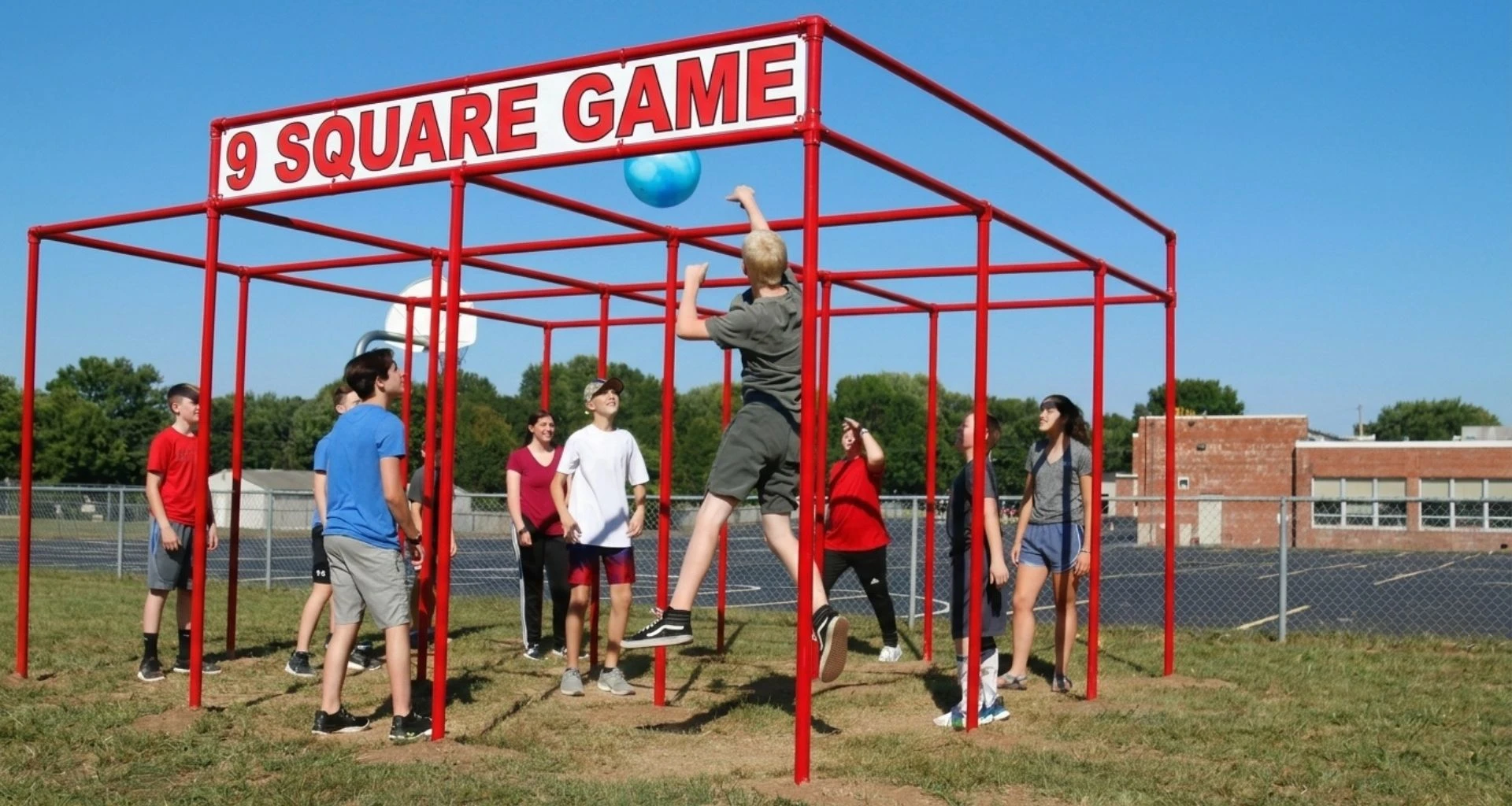
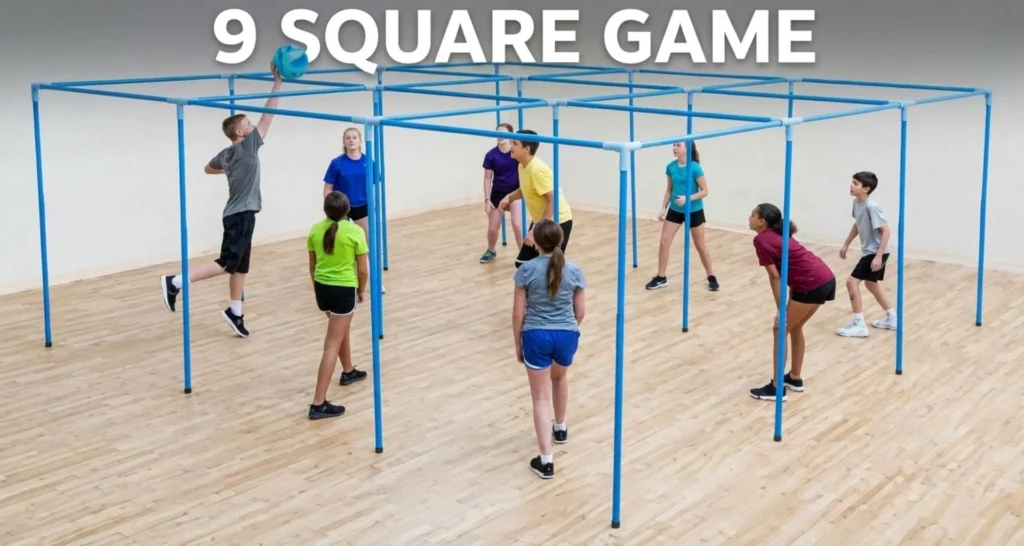
The 9 square game setup requires only a few simple items, which makes it extremely popular in schools and parks. The main requirement is a structured frame that divides the playing area into nine equal squares. This court layout is usually built using PVC pipes, ropes, or metal frames. A soft ball or volleyball is used depending on age and skill level.
The 9 square game equipment is affordable and easy to set up, which is why many schools adopt it as a permanent playground game. The structure must be safe, stable, and clearly marked to ensure smooth gameplay. Teachers often prefer portable setups so the game can be used indoors or outdoors.
| Equipment | Purpose |
| Grid Frame | Creates court structure |
| Ball | Main gameplay object |
| Markers | Defines square boundaries |
| Whistle | Controls timing |
A proper court layout ensures smooth rotation and improves team coordination. It also helps maintain a safe play environment during fast-paced matches.
Popular 9 Square Game Variations for Fun Activities and Parties
The 9 square game variations make the activity even more exciting. One popular version is the “King Square” rule where the center player controls the flow of the game. Another version includes timed rounds, where players compete for survival instead of elimination. These changes add creativity and keep the game fresh for repeated play.
The 9 square game party game version is especially popular in the USA and UK. It includes music, themed rules, and sometimes even glow-in-the-dark balls for night play. Schools also use foam balls or balloons to make it safer for younger children in 9 square game for kids sessions.
Popular variations include:
- King Square Mode
- Timed Survival Mode
- Team-Based Mode
- Soft Ball Beginner Mode
- Party Music Challenge Mode
These variations improve social interaction, encourage active play, and boost recreational game enjoyment for all age groups.
Benefits, Tips, and Strategies for Winning 9 Square Game
The 9 square game is more than entertainment. It builds important life and physical skills. It improves reflex skills, enhances hand-eye coordination, and strengthens teamwork skills through continuous interaction. Students develop better awareness, faster reactions, and improved movement skills while enjoying the game.
From a fitness perspective, it promotes kids’ fitness in a fun way. It keeps children active without traditional exercise routines. Teachers often prefer it because it supports school PE game objectives while keeping students engaged.
Key benefits include:
- Better coordination and reaction time
- Improved communication among players
- Increased focus and alertness
- Healthy physical movement
Winning strategies also matter. Players who succeed usually focus on game strategy, not just power. Controlled hits, smart positioning, and awareness of other players are key. Staying calm under pressure helps maintain better ball control and reduces mistakes.
9 Square Game for Schools, Indoor Spaces, and Outdoor Playgrounds
The 9 square game for school programs has become extremely popular because it combines learning and physical activity. Teachers use it as a structured PE activity that improves both fitness and teamwork. It is flexible enough for classrooms, gyms, and outdoor fields, making it a perfect indoor activity or outdoor activity depending on space availability.
In playgrounds, the game encourages students to interact, compete, and cooperate naturally. It also supports group activity learning, where students understand cooperation through real-time play. Schools in the USA and UK use it during recess, sports days, and team-building events.
In parties, it works as a 9 square game party game, bringing energy and excitement to large groups. Its adaptability makes it one of the most effective fun activities for children and teens.
Conclusion
The 9 square game continues to grow in popularity because it is simple, flexible, and highly engaging. It combines fitness, fun, and teamwork into one exciting experience. Whether used in schools, playgrounds, or parties, it delivers consistent enjoyment while building real physical and social skills.
Its balance of structure and freedom makes it a powerful recreational game for all ages. With easy setup, simple rules, and endless variations, the 9 square game remains a timeless choice for anyone looking for an active and enjoyable group experience in 2026 and beyond.
Frequently Asked Questions
1. What is the objective of the 9 square game?
The main objective of the 9 square game is to keep the ball in play while avoiding mistakes and staying in your square as long as possible. Players must react quickly, control the ball, and follow rotation rules when errors happen.
2. Is the 9 square game suitable for kids and beginners?
Yes, the 9 square game for kids is highly beginner-friendly. Schools often use soft balls and simple rules, making it safe and easy to learn for all age groups, especially in PE classes and playground activities.
3. What equipment do I need to play 9 square game?
You only need a court frame, usually made of PVC pipes or ropes, and a ball such as a volleyball or foam ball. This simple 9 square game setup makes it ideal for schools and outdoor playgrounds.
4. Can the 9 square game be played indoors?
Yes, the 9 square game indoor version is very popular in gyms and halls. It requires limited space and can be adapted with lighter balls to ensure safety and smooth gameplay.
5. What skills does the 9 square game improve?
The 9 square game improves reflex skills, hand-eye coordination, teamwork, and movement control. It also enhances focus, reaction speed, and social interaction through active group participation.